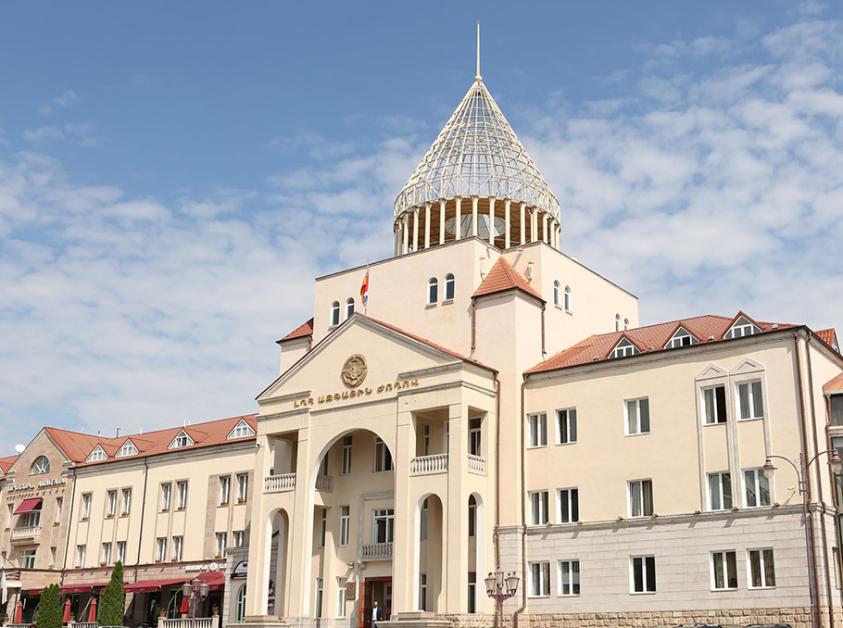
Recognize the independence of the Republic of Artsakh: the message of the National Assembly of Artsakh to the member states of the United Nations
The National Assembly of Artsakh issued a message calling on the member states of the United Nations to recognize the independence of the Republic of Artsakh.
The message says:
"Based on the UN Charter, the 1948 UN Universal Declaration of Human Rights, the 1948 UN Convention on the Prevention and Punishment of the Crime of Genocide, the 1950 European Convention for the Protection of Human Rights and Fundamental Freedoms, "All forms of racial discrimination on the Elimination of Forms" of the 1965 International Convention on Human Rights and other international treaties in the field of International Human Rights and Humanitarian Law, the 1974 "Definition of Aggression" resolution of the UN General Assembly, the 2005 UN General Assembly "Protection of Population from Genocide, Ethnic Cleansing and Against Humanity" "On the obligation to protect against crimes" resolution, "On the declaration of the Nagorno-Karabakh Republic" of September 2, 1991, the results of the referendum on the independence of the Nagorno-Karabakh Republic on December 10, 1991, "On the basics of the independence of the Nagorno-Karabakh Republic" on January 6, 1992 of the law, the decision of the NKR Supreme Council "On approving the text of the NKR State Independence Declaration" of January 6, 1992, the agreement between the parties to the conflict on May 12, 1994 "On the complete cessation of fire and hostilities", on March 31, 1995 OSCE The document adopted by the first meeting of the management team, 2020 The Trilateral Declaration signed by Russia, Armenia and Azerbaijan on the cessation of all military operations in Nagorno-Karabakh on November 9, the decision of the European Court of Human Rights on December 21, 2022, the European Parliament's decision on January 19, 2023 "On the humanitarian consequences of the blockade of the Lachine Corridor" the resolution on the decisions of the International Court of Justice of the United Nations of February 22, 2023 (reaffirmed on July 6), the resolution of the Parliamentary Assembly of the Council of Europe of June 22, 2023;
Strictly condemning that the Azerbaijani side regularly violates the 2020 the provisions of the November 9 Tripartite Declaration.
Calling attention to the fact that until now Azerbaijan has not fulfilled its obligations to release Armenian prisoners of war and hostage civilians and is preventing the return of internally displaced persons to Nagorno-Karabakh and neighboring regions in every possible way, which, according to the provisions of the Declaration, should have happened by the UN High Commissioner for Refugees under the supervision of the Commissioner.
In the period that passed after the signing of the tripartite declaration, the threats posed by Azerbaijan to the civilian population of Artsakh not only decrease, but also significantly increased. In this regard, we record the following facts.
-Azerbaijan, at the same time as Armenia, on January 30, 1992, became a member of the Council on Security and Cooperation of Europe (CSCE, since 1995 - OSCE), assumed obligations.
The CSCE has recognized the sovereignty of these countries, provided that they, in turn, accept the fact of disagreements regarding the ownership of Nagorno Karabakh and agree that the future status of Nagorno Karabakh will be decided at an international conference, which will take place under the auspices of the CSCE. Both states have given their consent, undertaking to solve the problem peacefully.
Azerbaijan violated its commitments and unleashed a large-scale aggression against the Republic of Nagorno Karabakh (Artsakh). By organizing its self-defense, the Republic of Nagorno-Karabakh (Artsakh) showed worthy resistance and defended its independence in the war initiated by Azerbaijan in 1992-1994. In May 1994, Azerbaijan had to sign an agreement with the Nagorno-Karabakh Republic on "Complete Cessation of Fire and Hostilities", which was recognized by the international community.
- The Republic of Azerbaijan, violating all norms of international law and disrupting the process of multi-year negotiations on the peaceful settlement of the Nagorno Karabakh conflict under the auspices of the OSCE Minsk Group co-chair, on April 2, 2016 again unleashed a large-scale military aggression against the Republic of Nagorno Karabakh (Artsakh), which was stopped by Russian Federation.
- Despite the agreement reached on the ceasefire, Azerbaijan, with Turkey's comprehensive support and direct management of military operations, with the involvement of thousands of mercenary terrorists from various countries of the Middle East, again resorted to large-scale military aggression on September 27, 2020.
Against the Republic of Nagorno Karabakh (Artsakh), which was suspended in 2020, on November 9, as a result of the signing of the Trilateral Declaration "On the cessation of all military operations in Nagorno-Karabakh by the leaders of Russia, Armenia and Azerbaijan".
- By the order and coordination of the military-political leadership of Azerbaijan in 2022. On December 12, a group of Azerbaijanis, under the name of "environmentalists", entered the area of responsibility of the Russian peacekeeping mission at the intersection of the Shushi-Karintak road and blocked the only land Lachin corridor between Nagorno Karabakh (Artsakh) and the Republic of Armenia, also disrupting the supply of energy carriers, gas, through that area. and electricity supply.
- On December 21, 2022, the European Court of Human Rights adopted a decision obliging Azerbaijan to take all necessary and sufficient measures to ensure the movement of seriously ill persons in need of medical care in Armenia through the Lachin Corridor.
- On February 22, 2023, the UN International Court of Justice adopted a decision that Azerbaijan is obliged to take all necessary and sufficient measures to ensure the unhindered movement of people, vehicles and cargo through the Lachin Corridor in both directions, which was reaffirmed on July 6.
- Disregarding 2020 the provisions established by the Tripartite Declaration of November 9, the decisions of the European Court of Human Rights on December 21, 2022 and the UN International Court of Justice on February 22 and July 6, 2023 reaffirmed, Azerbaijan on April 23 of this year, illegally a checkpoint placed in the corridor, deepening the blockade, and taking the Republic of Nagorno Karabakh (Artsakh) under complete siege from June 15.
- As a result of such anti-human actions, 120 thousand civilians living in Artsakh (including 30,000 children) faced the real danger of ethnic cleansing by Azerbaijan, and around 30 thousand forcibly displaced people still cannot return to their permanent places of residence.
Pursuing the undisguised goal of depopulating Artsakh and annexing it by force and violating the existing norms of international law with impunity, Azerbaijan consistently illegally occupies new territories of the Republic of Nagorno-Karabakh (Artsakh), regularly shelling Armenian settlements, killing and terrorizing the civilian population disrupts its normal life in every way, making people's lives unbearable, and at the same time carries out acts of vandalism against the Armenian historical and cultural heritage.
Warning that the population of the NK (Artsakh) Republic, under siege by Azerbaijan, is facing the danger of DESTINATION and GENOCIDAL actions carried out by the Azerbaijani authorities.
Taking into account the genocidal policy implemented by Azerbaijan towards the population of Artsakh and the most serious existential threats facing its population, the National Assembly of the Republic of Nagorno Karabakh (Artsakh), the highest representative body endowed with the primary mandate of the people of Artsakh, expressing the will and position of the entire population of the republic,
He ADDRESSES the member states of the United Nations
with a message
AND MAKES AN APPEAL
Guided by the principle of the right of nations to self-determination enshrined in the UN Charter, taking as a basis the declaration of September 2, 1991 "On the Declaration of the Republic of Nagorno-Karabakh", the results of the referendum on independence of December 10, 1991, the NKR Supreme Council "On the Basics of the Independence of the Republic of Nagorno-Karabakh" "The law of January 6, 1992, the decision of the NKR Supreme Council "On approving the text of the NKR state independence declaration" of January 6, 1992, to recognize the independence of the Republic of Nagorno Karabakh (Artsakh).
- It is undeniable that there are all the necessary grounds for recognition. The Republic of Nagorno-Karabakh (Artsakh) exercised its right to self-determination without violating the territorial integrity of Azerbaijan, without violating the relevant provisions of the USSR Constitution, the definition of the Law of April 3, 1990 "On the Withdrawal of Union Republics from the USSR", according to which "Autonomous republics and autonomous entities have the right have the right to independently decide the issue of staying in the union or in the union republic leaving its structure, as well as to regulate the issue of their own state legal status", all the norms of international law.
- We are more than convinced that the recognition of the Republic of Nagorno-Karabakh (Artsakh) by the UN member states will become a reliable guarantee of security for our people, will contribute to the creation of favorable conditions for their normal life in their historical homeland, as well as to ensure stability, long-term and permanent peace in the South Caucasus region. .
- We are deeply convinced that the only way to prevent the impending tragedy is to recognize the independence of the Republic of Nagorno Karabakh (Artsakh) based on the principle of RECOGNITION FOR SALVATION," the message reads.
Add new comment