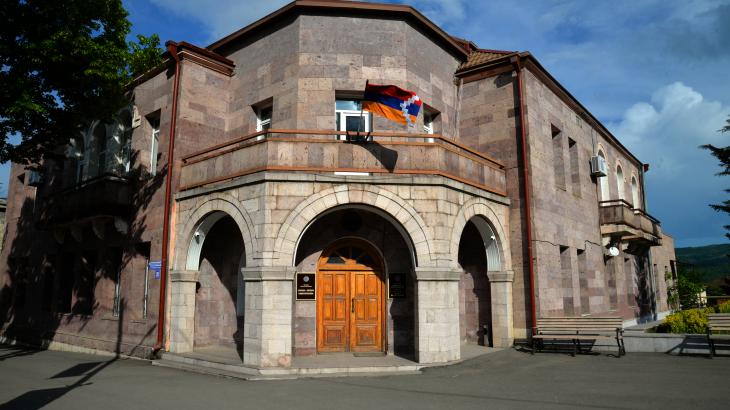
The vision proposed by the Russian side of the dialogue between Stepanakert and Baku is not balanced. Artsakh MFA
The Ministry of Foreign Affairs of the Artsakh Republic issued a comment on the statement made by the Russian Foreign Minister to the press following the tripartite meeting in Moscow. It says: "On July 25, 2023, we consider it necessary to note the following regarding the comments made by the Minister of Foreign Affairs of the Russian Federation to the media following the tripartite negotiations with the Foreign Ministers of Armenia and Azerbaijan.
The Republic of Artsakh highly appreciates the long-term mediation efforts of the Russian Federation, which are carried out both individually and as the co-chairing country of the OSCE Minsk Group. We are grateful to Russia for its exceptional contribution in stopping the 44-day aggression of Azerbaijan against Artsakh and for the peacekeeping mission in Artsakh.
We have taken note that during the meeting, the Russian side presented its assessments regarding the steps that it is highly desirable to take immediately and without delay in favor of the provision of food, medicine and basic necessities to the people of Artsakh, as well as to ensure the uninterrupted supply of electricity and gas.
Without doubting Russia's desire to help the parties to achieve a long-term solution to the Azerbaijani-Karabakh conflict and contribute to the normalization of relations between Armenia and Azerbaijan, we nevertheless consider it necessary to note that the vision offered by the Russian side of the dialogue between Stepanakert and Baku is not balanced. The claim that it is necessary to hold a dialogue to agree on the rights arising from international obligations, including the conventions on the protection of the rights of national minorities, reflects the point of view of only one side, Azerbaijan. Such an approach predetermines the outcome of a possible dialogue and thereby undermines and devalues its meaning.
The assertion that the Azerbaijani-Karabakh conflict is a matter of ensuring the rights of the national minority is a false statement put forward by Azerbaijan to distort the nature of the conflict and to justify its refusal to recognize the right to self-determination of the people of Artsakh, a fundamental principle of international law to which Russia has repeatedly referred. Attempts to find a solution to the Azerbaijani-Karabakh conflict within the logic of ensuring the rights of national minorities are disconnected from reality and cannot lead to a fair, balanced and dignified peace. Considering that Azerbaijan openly despises 2020. The provisions of the Tripartite Declaration of November 9, as well as its international obligations regarding the implementation of legally binding decisions of the International Court of Justice of the United Nations, the fulfillment of the requirements of international humanitarian law and the elimination of all forms of racial discrimination, any claim that Azerbaijan will voluntarily maintain some mechanisms, fully is baseless. Attempts to impose such a vision of conflict settlement are fraught with disastrous consequences.
Regarding the statement that the most sensitive issue of the negotiations "was and remains the issue of guaranteeing the rights and security of the Armenians of Nagorno-Karabakh in the context of ensuring the territorial integrity of Azerbaijan and in full accordance with the declaration signed by the leaders of the former Soviet republics in Alma-Ata in 1991", we consider it appropriate again to remind that before the signing of that document, the Republic of Artsakh had already completed the process of withdrawing from the Azerbaijan SSR, in accordance with the legislation of the Soviet Union and the norms of international law.
Moreover, the Declaration of Alma-Ata, like any international document, should be guided by the UN Charter and other universal norms and principles of international law. Therefore, the Declaration of Alma-Ata contains the same principles and norms as the UN Charter, including the right to self-determination. At the same time, the interpretation of the relationship between different legal norms is subject to the general logic of the development of international law and international practice. In this regard, we consider it necessary to emphasize that in cases of mass serious violations of human rights and discriminatory policies, the right to secession based on the principle of self-determination of nations takes precedence over the principle of territorial integrity of states. This resolution, in particular, is described in the Declaration on the Principles of International Law on Friendly Relations and Cooperation between States, to which the Minister of Foreign Affairs of the Russian Federation has repeatedly referred. We agree with the comment repeatedly voiced by the Russian side regarding the relationship between the right to self-determination and the principles of territorial integrity. This approach is also fixed in the judicial practice of different countries.
We strongly urge the international actors to be guided exclusively by the principles of international law and the interests of the people who have been on the verge of a humanitarian disaster and under the growing threat of ethnic cleansing for almost 8 months in the settlement of the Azerbaijani-Karabakh conflict.
Add new comment