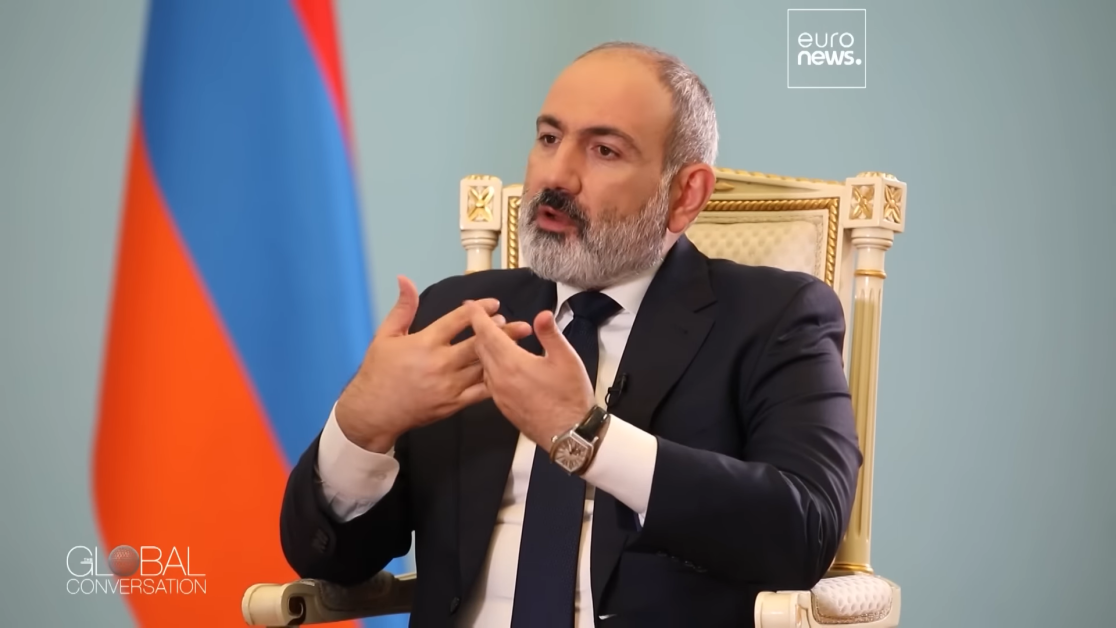
Aliyev did not publicly confirm mutual recognition of territorial integrity. Pashinyan to “Euronews”
Prime Minister Nikol Pashinyan gave an interview to Euronews TV. The question and answer are presented below.
Euronews - Mr. Prime Minister, my first question is about Nagorno-Karabakh, which is currently in a violent phase in the South Caucasus. The tension has not subsided even after the 2020 peace agreement. What are the reasons for the ongoing hostilities?
Prime Minister Nikol Pashinyan - First of all, I must say that the document signed on November 9, 2020 is not a peace agreement or, as you called it, a peace deal in its legal aspect. But not so much de jure as de facto a number of its provisions are grossly violated, because yes, I agree with you that it can be and is a certain vision of the future architecture of peace.
Unfortunately, for example, many provisions are regularly violated by Azerbaijan and are violated. You mentioned your question by talking about Nagorno-Karabakh, and it is understandable to everyone. But, for example, Azerbaijan continues to insist that there is no Nagorno-Karabakh, despite the existence of the "Nagorno-Karabakh" entity defined in the tripartite statement of November 9, and the president of Azerbaijan also signed under that statement. Furthermore, it is noted that there is a line of contact in Nagorno-Karabakh, and Nagorno-Karabakh has a territory defined by point 7 of the tripartite declaration. Furthermore, point 7 of the same statement stipulates that refugees and internally displaced person return to Nagorno-Karabakh territory and adjacent regions under the auspices of the Office of the United Nations High Commissioner for Refugees. Unfortunately, Azerbaijan has not ensured this obligation and this right to date. Moreover, construction works are being carried out in a number of villages depopulated during the war, and Azerbaijan announces that it will resettle these areas with Azerbaijanis.
Not to mention that, contrary to point 8 of the tripartite declaration, the captives, hostages, and other detained persons have not been returned. Until recently, there were 33 prisoners from the Republic of Armenia, from the Armenian side, and recently 2 people were kidnapped.
The Lachin Corridor, which is further defined by the tripartite declaration you mentioned and which aims to ensure the connection of Nagorno Karabakh with the Republic of Armenia and according to which, including the signature of the President of Azerbaijan, should be under the control of Russian peacekeepers, moreover, the Lachin Corridor is not only a road, I want to draw your attention, but also a 5-kilometer wide space is illegally blocked by Azerbaijan.
Euronews - We will take a look at the Lachin Corridor. Now I want to ask a question about the current peace negotiations. You have just returned from Brussels, where you met with the President of Azerbaijan. You have also met several times through the mediation of the EU. These peace talks have given many people hope for lasting peace. To what extent is peace possible?
Prime Minister Nikol Pashinyan - Peace is not only possible, but must be. That's my approach, that's my belief and faith. But in order for this to happen, it is also important that the international community is aware of certain nuances in order to understand why the progress is not at a sufficient pace.
I can start from our penultimate meeting in Brussels, when in the presence of the President of the Council of the European Union Charles Michel, we agreed with the President of Azerbaijan, reached an agreement that Armenia and Azerbaijan mutually recognize each other in the case of Armenia of 29,800 square meters and the territorial integrity of 86,600 square meters, after which Charles Michel issued a corresponding statement, after which, when Armenian journalists asked me about it, I publicly confirmed that fact. Until now, the president of Azerbaijan has not publicly confirmed this agreement. It's true, he didn't even deny it. This is a subtlety that creates a certain additional lack of confidence.
We also have an agreement between Baku and Stepanakert, which is the capital of Nagorno-Karabakh, the main city, there should be a dialogue about the rights and security of the Armenians of Nagorno-Karabakh within the framework of the international mechanism. That dialogue hasn't happened yet either. But we must work consistently. No one promised that achieving peace would be easy. If it were easy, peace would have been established long ago.
Euronews - What about the EU mediation? Many international actors have tried to mediate to find a solution to this crisis: Russia, the United States, and now the EU has taken on an even bigger role. What new thing did they bring to the negotiations?
Prime Minister Nikol Pashinyan - You know, first of all I would like to emphasize that the advantages of mediation in general have been known for a long time and to everyone, but all mediations have certain disadvantages. Every mediation has its own unique drawback, and if you will allow me, I will talk about the drawback.
For example, look, in terms of the Brussels platform, we see the following problem, and it is continuous, that we agree at the table, we reach certain agreements in the presence and testimony of the President of the Council of the European Union. And if any of the parties does not address these agreements, does not implement them, it is not even followed by specific evaluations. I can give you a specific example: in my presence, the President of Azerbaijan, in the presence of the President of the Council of the European Union, promised and undertook at the end of last year that within the next week to 15 days, it was last year, 10 prisoners will be released. So far, that commitment has not been fulfilled. But on the other hand, I assume that effective mediation is when, in case of non-fulfillment of agreements, at least a certain political attitude is formed towards the person who does not fulfill that obligation. For example, in the Brussels platform, we don't see that, and I have repeatedly raised this issue.
I can tell you a secret: we have even prepared a document called an audit, where we have listed the agreements that were reached on the Brussels platform, but were not implemented later. It turned out to be a very thick package, which is worrying.
Euronews - Do you mean that Brussels does not pursue the elimination of the shortcomings of one of the parties during the negotiations?
Prime Minister Nikol Pashinyan - If without diplomacy, yes.
Euronews - Do you think that the fact the West, the United States and Europe, have taken on a greater role here, has angered the traditionally regional power, Russia, or on the contrary, the fact that Russia is saddled with the Ukrainian issue has given space to other actors to come and try to help you and Azerbaijan find common ground.
Prime Minister Nikol Pashinyan - You know, in fact, such episodes happen when, figuratively speaking, we witness certain scenes of geopolitical jealousy. But I must also note with pleasure, and from different sides, not only from one side, but from different sides, such phenomena have been observed regularly, that it seems that there are already changes in certain emphases. And that change is as follows։ we are hearing statements from various quarters that they welcome and will welcome any platform that will be favorable to the peace process. And this is very important.
Moreover, I want to remind you that these scenes are not actually directly related to us, աս you know that the OSCE Minsk Group co-chairmanship was functioning, which was created to address the Nagorno-Karabakh problem, but from February 24, 2022, the co-chairmen actually physically stopped their work. contacts. A part of them decided they didn't want to associate with the other part. And there such a problem arose. In fact, the particular genre you mentioned, or what I call geopolitical jealousy, emerged after that date, because there was essentially no such genre before that. But on the other hand, it will certainly be more effective if international partners join their efforts. There are recent signs that they are, however, showing some interest in this logic, the second logic.
Euronews - President Vladimir Putin has invited you and the President of Azerbaijan to Moscow for a new round of negotiations. What can you say about Russia's current influence in this region?
Prime Minister Nikol Pashinyan - First of all, about the invitation, I have not received any invitation yet, I must emphasize this. As for Russia's presence, you know of course that due to the events in Ukraine, the attention of not only Russia, but also other geopolitical players towards our region is decreasing, because in practice, Ukraine focuses all international attention on itself. And of course there is a factor.
But Russia is present in our region, it is present in Nagorno Karabakh, it is present in the Republic of Armenia, but the European Union is also present. The civilian mission of the European Union on the border of Armenia and Azerbaijan is a new factor. Of course, the mission had to be on both sides, because that was the agreement reached in Prague in 2022 from the beginning during the quadrilateral declaration on October 6, at least it was then that the European Union mission came to our region for the first time, and initially there seemed to be an agreement that representatives of the European Union mission should be present on both sides of the border, but for some reason, Azerbaijan seems to be following it. refused.
Euronews - Let's talk about the situation on the ground. You mentioned Lacin Corridor. The International Court of Justice, the European Court of Human Rights, the US, the EU have all demanded guarantees regarding freedom of movement through the Lachine Corridor. What is happening in this regard, which is a crucial gate for the people of Nagorno Karabakh?
Prime Minister Nikol Pashinyan - First of all, I would like to separate the decision of the International Court of Justice from the other factors you listed, because the decision of the International Court of Justice has binding legal force, that is, it is the highest international court whose decisions have the highest legal force and that court based on the application of Armenia adopted a decision on February 22, 2012 that Azerbaijan should take all steps within its reach to ensure the two-way movement of vehicles, goods and citizens through the Lachin Corridor, and on July 6 reaffirmed that decision.
This is also very important from the point of view of the logic of the international legal system, because the decision of the highest court of international law is not implemented. In general, from the point of view of law and legality, I think it is a bad message globally and food for thought for the international community, at least we will work to raise this issue in international courts.
What is happening in Nagorno Karabakh? There is a humanitarian crisis in Nagorno Karabakh. What does humanitarian crisis mean? No food is supplied to Nagorno-Karabakh at all, there is no foreign supply food, there are no basic necessities, no baby food, no medicine, no hygiene items, no other basic necessities, the supply of natural gas to Nagorno-Karabakh has been stopped by Azerbaijan, the supply of electricity to Nagorno-Karabakh has been stopped by Azerbaijan, the fuel supply has been stopped by Azerbaijan. And in this sense we are facing a real threat of starvation there, health problems and so on and so forth.
Euronews - Azerbaijan continuously denies that they are doing it. They claim that the Aghdam road is accessible.
Prime Minister Nikol Pashinyan - Look, I don't know what you are talking about, because I am talking about the document that I signed and which has the status of an international document. It is very clearly written there that the Lachin Corridor, which is under the control of Russian peacekeepers, and which is not just a road, but a 5 km wide area, should be outside the control of Azerbaijan and should provide a connection between Nagorno Karabakh and Armenia.
In principle, you know, I'm sorry to say something a bit absurd, but the road from the moon to Nagorno-Karabakh is open, there are no checkpoints, but I can't talk about the institutes unknown to me, what kind of road it is, from Mars, from the moon. I'm talking about what is a documented concept. Now that road is closed, if anyone doubts, you can try to go to Nagorno Karabakh right now. By the way, yesterday the International Committee of the Red Cross already announced that due to the closure of the Lachin Corridor, it has no opportunity to deliver humanitarian aid to Nagorno Karabakh. What does this mean, this means: firstly, the International Committee of the Red Cross officially declares the need to deliver humanitarian aid to Nagorno-Karabakh, otherwise it would not have said that I cannot deliver aid, and secondly, it records that it cannot do it and the third cannot do because of the closure of Lachine Corridor. This was also followed, if I'm not mistaken, by the response of the international organization "Freedom House" with the call to ensure the access of humanitarian goods to Nagorno Karabakh.
The Armenian government made a decision yesterday and today the aid is on its way to send 400 tons of humanitarian cargo to Nagorno Karabakh. Let's see if that aid will go to Nagorno Karabakh or not. In other words, according to the tripartite statement and the decision of the International Court of Justice, that humanitarian aid should arrive. Now we will see if it will happen or not.
Returning to the humanitarian crisis, let me say the following. Of course, in Nagorno-Karabakh, especially in this season, certain agricultural works are carried out, but the military of Azerbaijan shoot at the persons carrying out agricultural works and agricultural equipment. Since 2020, we have had cases where a tractor driver was killed by an Azerbaijani sniper while doing agricultural work. But now even the tractor is not working because there is no fuel. And because of the lack of fuel, people cannot harvest, if by some miracle they harvest, let's say for example, grain, it is not possible to get that crop to the flour mills again because of the lack of fuel, if by some miracle they get flour, again it is not possible because of the lack of fuel deliver bread to baking factories, if by some miracle they deliver the flour, due to the lack of electricity, gas, it is not possible to produce bread in production volumes, if it is somehow possible to produce bread, again, due to the lack of transport, it is difficult or impossible to deliver this bread to the store. If it is possible to get to the store, public and private transportation is not working again due to lack of fuel for people to go and get that bread from the store.
If they somehow manage to get them to the store, because of this blockade, all the businesses have closed, everyone has lost their jobs, and people have no income to buy bread from the store. If by some miracle they have the necessary income to buy bread, the queues are so long and the product is so little that even if by some miracle they reach that store, the product that is sold little, by some miracle, by a miracle chain store, may simply not reach them.
And so, let's look at the same logic: baby food: imagine young mothers not having the opportunity to feed their children with baby food. Moreover, many of them may not have fed their children naturally from the very beginning, and started feeding them with baby food, and one day the baby food simply disappeared.
Euronews - I spoke with a journalist in Stepanakert who presented almost the same painful situation. I want to talk about 2020. Thousands of people died, soldiers and civilians. I was here, in Armenia, and I went to Nagorno Karabakh during that time, I spoke with the mothers of the fallen soldiers, I also witnessed the pain and destruction on the other side as a result of the work done by my colleagues in Azerbaijan. But I remember one of the mothers in Armenia who blamed her son's death on politicians who had learned the art of diplomacy but fell into the trap of war. In your opinion, is your mission to win a war or to negotiate for peace?
Prime Minister Nikol Pashinyan - War is wrong in all cases, that is, if there is a war, someone somewhere has done something wrong, or several people have done something wrong. If we look from the other side, what actually becomes the cause of war, the cause of war arises from the impossibility of maintaining peace or achieving long-term peace. And how real is that impossibility, how sincere, how original, that is another question.
You talk about a parent, a mother who talks about politicians. Of course, I understand and accept, and I do not dispute in any way the words of the mother, wife, or child of the fallen soldier. But we forget a fact that politicians are also people, it's not like they are such a species produced by some separate genetic reproduction. My son was in the war, my wife was also in the war, and yes, you are now raising a very serious question, which is certainly a legitimate question, but I think there are many depths there.
Throughout its existence, humanity has talked about avoiding wars, not allowing wars, and achieving peace. And suppose there are bad politicians in this building, but in the other thousands of other buildings around the world? There is a very easy explanation for this: there are people and there are politicians. Here these bad politicians do not allow people to live well, which is true by and large, in one reading, in the next moment, especially in a democratic society, they can change places: a politician can become a person, a person can become a politician and powerful, and the problem is that these cycles repeat themselves for thousands of years.
Euronews - You mentioned something very important here. There is a very specific and tragic cycle in this region, where the victory of one can be recorded only and only through the capitulation of the other. Today I spoke with a young Armenian who told me that he is a representative of the generation of independence and that when he was still very young, dialogues between Armenian and Azerbaijani children were organized with the mediation of Georgia. And he said that he remembers it very kindly. What do you think, if peace can be achieved, I mean a peace treaty can be concluded, will it be possible to achieve it in so much pain, or on the contrary, peace should be built from the bottom up?
Prime Minister Nikol Pashinyan - Yes, of course I believe. In continuation of my speech, I want to draw your attention to the following nuance. Politicians are actually both creators of public moods, and bearers of public moods, and influencers of public moods, and are affected by public moods. It is a very complicated system, but since you talked about youth, I remember in 2018 I put forward such an idea. I could see what kind of aggressive words Armenian and Azerbaijani users use on social networks. And at one of my public press conferences, I called for Armenian and Azerbaijani users of social networks, who mostly wrote comments under the same video on YouTube, to use that platform to talk, not to curse. I made a call at that time, but that call, of course, as it turned out later, did not have a sufficient result, or maybe we did not work in that direction with sufficient consistency.
In the logic of war, I want to say that we should never forget, conventionally speaking, the factor of the first blood, when somewhere there was a victim, blood was spilled, this is a very deep psychological, social, public and political moment. It is very difficult for both the public and politicians, in reality there is no such division. I say again, always know that yes, politicians influence the mood of the public, but they are also affected by the mood of the public and vice versa. It is very difficult sometimes to go all the way to such solutions, concessions, decisions that deep down may mean that the people who died in the past died in vain. This problem exists in all places and never in one place, from one side.
Look, you are talking about the victim's mother, imagine what an important factor it is, that you have now made it a topic of discussion in our conversation. But before or after that, a question may be raised, if you are now making such concessions or compromises, why did our children die, and no one has the answer to that question, no one can give it, never. And you should know that this question is on the table of any politician. Even if a person understands the necessity of not allowing victims in the future, he always knows that he will have to get the answer to the second question, why did those who died in the past die, then was that sacrifice pointless? So, again, the politicians simply took those Markians and killed them and that's it, isn't there any other meaning, content, goal, mission in all of that? And it is very difficult to explain to people that, you know, your son or daughter died for the sake of future peace, how to explain to a person that it is possible to die for the sake of peace, if our whole goal is peace.
Euronews - Are you losing sleep over what happened to your country? The thought of so many military and civilian victims does not give you peace, does it?
Prime Minister Nikol Pashinyan - Obviously, and naturally, of course, I don't think about it too much, but it is very difficult to put those thoughts aside for a moment and engage in everyday work.
Euronews - Mr. Prime Minister, and the last question. Do you have any message addressed to the other side, but not to the political leaders whom you are meeting because of the negotiations, but to the people of Azerbaijan? Do you have a message for those who may be watching us right now?
Prime Minister Nikol Pashinyan - You know, I think it's not a good genre, because when two politicians talk to each other, in fact, two peoples are talking, because on one side the one elected by that people speaks, on the other side the one elected by this people speaks. Therefore, what we are talking about is, of course, an international platform, it is also aimed at that people, but if there is anything to say, it can be said that what I said from the first second was also aimed at the people of Azerbaijan. In such cases, there are sentences on duty: they say that we have lived here for a long time and we have to live for a long time, I think all the words have been said. By the way, there is perhaps something that is aimed equally at the public of both Armenia and Azerbaijan, because the public of both Armenia and Azerbaijan should demand peace from their authorities. It should be formulated as a public demand and peace, flexibility and skill to fulfill that demand.
Euronews - Thank you for speaking to “Euronews”. I hope it will be possible to achieve peace.
Prime Minister Nikol Pashinyan - I am grateful.
Add new comment