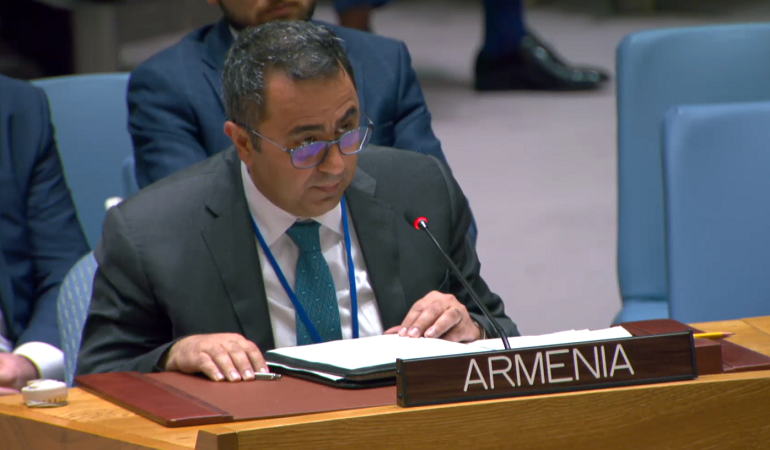
The existence of the NK people is under serious threat. Deputy Minister of Foreign Affairs of the Republic of Armenia to the open discussion of the UN Security Council
Vahe Gevorgyan, RA Deputy Foreign Minister, made a speech at the open discussion on "Global food insecurity as a result of hunger and conflict" organized by the United States under the agenda item "Maintenance of International Peace and Security" of the UN Security Council, which was chaired Anthony Blinken, the US Secretary of State.
The Deputy Minister of Foreign Affairs of Armenia drew the attention of those present to the humanitarian crisis in Artsakh, stressing that the existence of the people of Artsakh is under serious threat due to the complete blockade implemented by Azerbaijan.
"I want to thank the United States for inviting an open discussion on such a daily topic. I also thank the Rina Gelani, UN Hunger Prevention and Response Coordinator, and other distinguished speakers for presenting their views on ways to prevent and overcome hunger by strengthening food security in conflict situations.
Famine has been used as a means of war and genocide many times throughout history. But today I am not going to recall examples from the past or assess the future risks of famine in the context of the conflict. Instead, I will bring to the attention of the board a reality that is happening right now: a situation where people do not know if they will be able to find baby food for their babies, find a piece of bread for their children, or provide medicine for seriously ill relatives.
While we are here, the existence of the people of Nagorno-Karabakh is under serious threat due to the total blockade implemented by Azerbaijan. For more than seven months, Azerbaijan continues to block the Lachin Corridor, the only lifeline connecting Nagorno-Karabakh with the outside world. This illegal and inhuman act is a clear violation of the decision of the International Court of Justice adopted on February 22, 2023 and reaffirmed on July 6, the norms of international humanitarian law and the tripartite declaration of November 9, 2020.
Since 15 June this year, Azerbaijan's complete suspension of all humanitarian supplies has resulted in severe shortages of food, medical supplies and other essential goods, creating an extreme humanitarian crisis. Power and gas outages have paralyzed social and health services and the transportation system, depriving the besieged people of their basic human rights.
The blockade has a particularly disastrous effect on the most vulnerable groups of the population. Due to the lack of basic food and vitamins, about 2,000 pregnant women, about 30,000 children, 20,000 elderly people and 9,000 people with disabilities are struggling to survive with malnutrition, basic supplies and medicine.
Furthermore, Azerbaijan continues to target civilians engaged in agricultural work, expanding its apparent acts of starvation on the population.
The International Committee of the Red Cross, the only international humanitarian mission in Nagorno-Karabakh, has also been warned about the worsening situation on the ground. The International Committee of the Red Cross, in its statement on July 25, expressed concern over the daily increasing humanitarian needs and emphasized that it is currently unable to deliver humanitarian aid to the civilian population through the Lachine Corridor, stressing that its humanitarian aid convoys are a lifeline for the local people. 3 days after that, Azerbaijan abducts 68-year-old Vagif Khachatryan, who was transferred from Nagorno Karabakh to Armenia for treatment by the ICRC. The arrest of a person under the protection of the ICRC, whose transfer was pre-arranged with Azerbaijan, is not just a ruse, but a carefully planned move aimed at hindering the work of the ICRC in Nagorno-Karabakh.
In order to meet the life-saving needs of the most vulnerable classes, on July 26, the Armenian government decided to supply Nagorno-Karabakh with about 360 tons of essential goods, mainly food and medical supplies. We have appealed to the peacekeeping forces of the Russian Federation to organize the delivery of humanitarian aid to those in need in the same way as it was done in previous months. However, the humanitarian cargo still remains at the entrance to the Lachin Corridor due to the Azerbaijani side's obstruction and refusal to transport it.
The severe humanitarian situation prevailing on the ground and the growing risks of famine in Nagorno-Karabakh require an effective and immediate response from the international community to ensure the full and unconditional implementation of the decisions of the International Court of Justice and full respect for international human rights and international humanitarian law," said the RA Deputy Foreign Minister.
He expressed hope that the statement of the UN Secretary General on August 2, in which he expressed deep concern about the humanitarian situation and emphasized the need to implement the decisions of the International Court of Justice to ensure the unhindered movement of people, vehicles and cargo through the Lachine Corridor, will be the first a step towards more active UN engagement on the ground.
"It is needed more than ever. The price of inaction is extremely high, and this mass atrocity carried out through starvation is necessary and possible to prevent and stop," the deputy minister noted.
He called on the United Nations and the UN Security Council to take urgent measures to ensure the unconditional fulfillment by Azerbaijan of its obligations under international humanitarian law and the binding decisions of the International Court of Justice, the restoration of freedom of movement through the Lachine Corridor, restoring freedom of movement through the Lachine Corridor and the safe and uninterrupted humanitarian access of UN agencies and the ICRC to Nagorno-Karabakh.
Add new comment