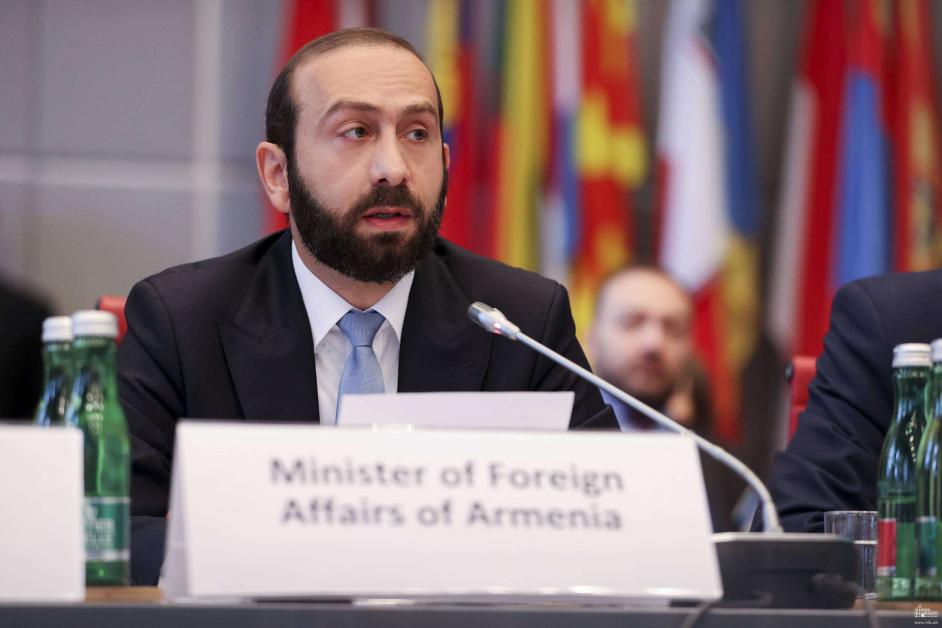
Prevention of genocide is the main responsibility of the UN and the Security Council. Ararat Mirzoyan
At the urgent session of the UN Security Council, RA Minister of Foreign Affairs Ararat Mirzoyan made a statement:
"Madam President,
Dear Colleagues,
I would like to thank the Security Council for convening this emergency meeting to discuss the humanitarian situation in Nagorno-Karabakh created by the 8-month blockade of the Lachin Corridor, the only road connecting Nagorno-Karabakh to Armenia and the outside world.
I am here today to seek the support of this prestigious body in maintaining the prospect of achieving just and comprehensive peace and stability in our region, which is being seriously undermined by Azerbaijan's instigation of a humanitarian disaster in Nagorno-Karabakh.
During the last two years, Armenia, with the support of the international community, spared no effort to establish peace and stability in our region. And I think that today we still have a chance to achieve this goal. However, the current humanitarian situation in Nagorno-Karabakh can greatly worsen the prospects for peace in the entire South Caucasus region and beyond.
Ladies and gentlemen,
Today I would like to elaborate by suggesting that you judge yourself not on the basis of excuses that you might consider true or false, but on values and facts.
The Universal Declaration of Human Rights begins with the recognition of the inalienable dignity and equal and inalienable rights of all members of humanity as the foundation of freedom, justice and peace in the world. Regardless of where they live, all people are endowed with the same rights and dignity and should be treated with the utmost respect and care, even in times of war. Unfortunately, the people of Nagorno-Karabakh are deprived of such treatment, being in a complete blockade.
Now let me present the events, facts and figures that show the realities of the besieged Nagorno-Karabakh.
November 9, 2020: A tripartite statement signed by the leaders of Armenia, Russia and Azerbaijan, according to point 6, "Lachin Corridor (5 km wide), which will provide a connection between Nagorno-Karabakh and Armenia..., will remain under the control of the peacekeeping forces of the Russian Federation."
December 12, 2022: Azerbaijan blocked the Lachin Corridor under the false pretext of environmental concerns. Since then, the gradual use of limited domestic supplies has led to acute food shortages and store closures. Before the blockade, about 90% of the food consumed was imported from Armenia, and today the population of Nagorno-Karabakh does not receive 400 tons of basic necessities per day. There is currently a severe shortage of food, including baby food, flour, sugar, as well as medicine, fuel, etc. Moreover, due to the lack of fuel and the targeting of workers by the Azerbaijani side, almost all agricultural work has been stopped. As a result, about 10,000 hectares of land near the contact line remain uncultivated.
December 20, 2022: The UN Security Council discussed the issue for the first time, and an overwhelming majority of council members called on Azerbaijan to lift the blockade.
in 2022 periodically from December and in 2023. since March completely (about 180 days in total) Azerbaijan has disrupted the only supply of natural gas to Nagorno Karabakh. The cessation of gas supply has already led to a number of negative humanitarian consequences, such as: 1. Disruption of hospitals, 2. Disruption of educational processes in schools and kindergartens, 3. Disruption of vital institutions and social services, 4. Inability to heat people's homes with gas, 5. Loss of access to hot water in many homes, 6. Lack of fuel for vehicles. etc.
in 2023 since January 9 /more than 210 days/ Azerbaijan disrupted the electricity supply on the only high-voltage line between Armenia and Nagorno-Karabakh. Since then, relying only on limited local electricity resources, Nagorno-Karabakh has been forced to implement intermittent blackouts of only a few hours.
February 22, 2023. The International Court of Justice applied an urgent measure in the framework of the International Convention on the Elimination of All Forms of Racial Discrimination (Armenia v. Azerbaijan), according to which Azerbaijan must "take all necessary measures to ensure that persons, vehicles and cargo through the Lachin Corridor: uninterrupted movement in both directions".
April 23, 2023. Azerbaijan, violating the decision of the International Court of Justice and the 2020 the tripartite statement of November 9, placed a checkpoint in the corridor of Lachin.
June 15, 2023: Azerbaijan went further by closing the Lachin Corridor entirely, barring any, even humanitarian, access to Nagorno-Karabakh, including the International Committee of the Red Cross.
July 6, 2023. The International Court of Justice reaffirmed the 2023 its decision of February 22.
July 25, 2023. ICRC, the only international humanitarian organization that has been operating in Nagorno-Karabakh for more than 30 years, announced. "Despite persistent efforts, the ICRC is currently unable to deliver humanitarian aid to the civilian population through the Lachine Corridor or other routes."
July 26, 2023: The Republic of Armenia sent a humanitarian convoy, which remains at the entrance to the Lachin Corridor, as the Azeri side refuses entry.
August 2, 2023. The UN Secretary-General reiterated his deep concern about the challenges to free movement through the Lachine Corridor, recalling the previous statement on the need to implement the decisions of the International Court of Justice, "including the 2023 adopted on February 22 and 2023 July 6 reaffirmed decisions regarding the uninterrupted movement of persons, vehicles and cargo in both directions through the Lachine Corridor." The Secretary-General further expressed particular concern about the deteriorating humanitarian situation on the ground and called for "urgent steps to facilitate access to humanitarian aid for people in need".
August 7, 2023. UN Group of Human Rights Experts. The Special Rapporteur on the right to food, the Special Rapporteur on the right to education, the independent expert on the enjoyment of all human rights by older persons and the Special Rapporteur on the rights of persons with disabilities have raised the alarm about Azerbaijan's ongoing blockade of the Lachin Corridor and the dire humanitarian crisis that has "put the population in dire straits." in front" and "put the lives of residents, especially children, people with disabilities, the elderly, pregnant women and patients in serious danger."
Some more data.
120,000 - the number of people living in Nagorno-Karabakh who are deprived of the opportunity to exercise their fundamental rights.
20,000 - the number of elderly people who do not even have the opportunity to move due to the lack of public transport.
30,000 - the number of children living in Nagorno-Karabakh who suffer from malnutrition and lack of food.
270 - the number of children who cannot return to Nagorno Karabakh and reunite with their families.
2000, the number of pregnant women living in Nagorno-Karabakh who do not have even basic access to health services.
9,000 - the number of persons with disabilities who are deprived of proper medical care.
4,700 and 8,450, the number of people with diabetes and blood circulation diseases, respectively, who run out of essential medicines.
All these events have doubled the number of deaths in NK during the last 8 months. Moreover, the lack of medicines, disinfectants and other hygiene items creates a risk of epidemics.
710, the total number of patients evacuated under the ICRC escort during the entire blockade and their accompanying persons, who went through a humiliating procedure in order to prove their health status and receive a "permit" to evacuate.
1: a man with a clear name, Vagif Khachatryan, who was kidnapped near the checkpoint on his way to Armenia for surgery under ICRC escort. He was kidnapped while under international humanitarian protection. This is not the only incident when Azerbaijan deliberately obstructed the work of the ICRC.
1: another person with a clear name: Karo Hovhannisyan, who passed away yesterday. According to the autopsy report, he died due to starvation and prolonged malnutrition.
2: 3-year-old Leo and 6-year-old Gita, who died in Martakert because their mother had to leave the children alone and walk to a nearby town in the hope of finding food for them.
Ladies and gentlemen,
In previous months, many of you have tried to address the problem of opening the Lachine Corridor. However, despite all the appeals, in 2020 The situation has not improved in line with the obligations assumed by the tripartite declaration of November 9, the legally binding decisions of the International Court of Justice. On the contrary, Azerbaijan has gradually but consistently intensified the blockade, up to the complete siege of Nagorno Karabakh. Armenia has expressed its concern regarding the deepening of the humanitarian crisis due to the closure of the Lachin Corridor in all negotiations with Azerbaijan, which were separately assisted and mediated by the USA, the EU, and Russia. And yet in vain.
Azerbaijan's involvement throughout this period can be described as anything but conscientious. During the first Security Council discussion on this issue, Azerbaijan refused to accept any responsibility for its actions and even stated that it does not control the Lachin Corridor. During the last eight months, Azerbaijan has put forward a number of excuses to justify its actions. First there were so-called eco-activists, concerned about environmental protection, then baseless accusations of transporting weapons through the Lachine Corridor, later military provocations, etc.
The Lachin Corridor was agreed upon as a link between Armenia and Nagorno-Karabakh and has no alternative. The Lachin Corridor should be opened, and as for other possible communications, it should be resolved within the framework of the international mechanism of the Baku-Stepanakert dialogue.
So today I am here to ask for your support in solving humanitarian problems, and we expect from this council:
- to condemn the use of starvation against civilians as a method of war, which is prohibited by international humanitarian law,
- -Condemn the illegal denial of humanitarian aid and the deprivation of the necessities of life to the civilian population of Nagorno-Karabakh, including the deliberate obstruction of access to aid delivery and to respond to conflict-induced food insecurity,
- demand full fulfillment of obligations under international humanitarian law, including the protection of civilians, particularly women and children, as well as important civil infrastructures,
- call for the immediate restoration of the freedom and safety of movement of people, vehicles and cargo through the Lachine Corridor, in accordance with the previously reached agreements,
- ensure full cooperation with the International Committee of the Red Cross and the safe and unimpeded supply of humanitarian aid,
- Send an independent interagency needs assessment mission to Nagorno Karabakh and provide humanitarian aid to the affected population.
These humanitarian issues should obviously be resolved with the decisive intervention of the international community, before the negative consequences lead to the ethnic cleansing of the NK people. According to the elected representatives of Nagorno-Karabakh, "this is a premeditated crime due to the obvious intention to commit genocide. The authorities of Azerbaijan deliberately provoked the blockade of Lachin Corridor, knowing that it would lead to the gradual destruction of the entire population of Nagorno-Karabakh, but they chose to continue such a course of action.
At the same time, the report of the former prosecutor of the International Criminal Court, Luis Moreno Ocampo, states that what is happening in Nagorno Karabakh is already a genocide. According to Ocampo, "Azerbaijani security forces' blockade of the Lachin Corridor, which prevents access to any food, medical supplies and other basic necessities, should be considered genocide under Article II, paragraph (c) of the Genocide Convention; "deliberately creating bad conditions for life is equal to physical destruction." Hunger is the invisible weapon of genocide. Without immediate drastic changes, this group of Armenians will be destroyed in a few weeks."
Dear Security Council, Preventing such a disaster is the primary responsibility of the United Nations and this Council. I really believe that this landmark structure, despite the geopolitical differences, can act as a genocide prevention structure, not a genocide commemoration structure, when it will be too late.
In conclusion, I would like to return to the very beginning of my speech. One of the most important principles of the United Nations is not to neglect anyone, and 4-year-old Edwin, 6-year-old Anastasia, 7-year-old Maria, 5-year-old Davit, 6-year-old Karine, 7-year-old Vahe, 5-year-old Tatev, 8- old Samvel and many others still hope that they will not be ignored.
Thank you."
Add new comment